
By Dave Wright, Policy Director, Spectrum for the Future Coalition
At this year’s Mobile World Congress in Barcelona, private cellular networks were everywhere. Not as a concept or a roadmap item—as deployed, operational infrastructure. Companies across manufacturing, aviation, logistics, and healthcare were comparing deployment models and scaling operations. The question is no longer whether private networks work. It’s who has the spectrum framework to support them.
Right now, the United States has a clear advantage—and it’s called CBRS.
A Major U.S. Airport Shows What’s Possible
One of the most compelling moments at MWC came during the Smart Airports Summit, where Eduardo Valencia, CIO of Minneapolis–St. Paul International Airport, described how MSP deployed a private cellular network powered by the Citizens Broadband Radio Service to modernize one of the country’s busiest airports.
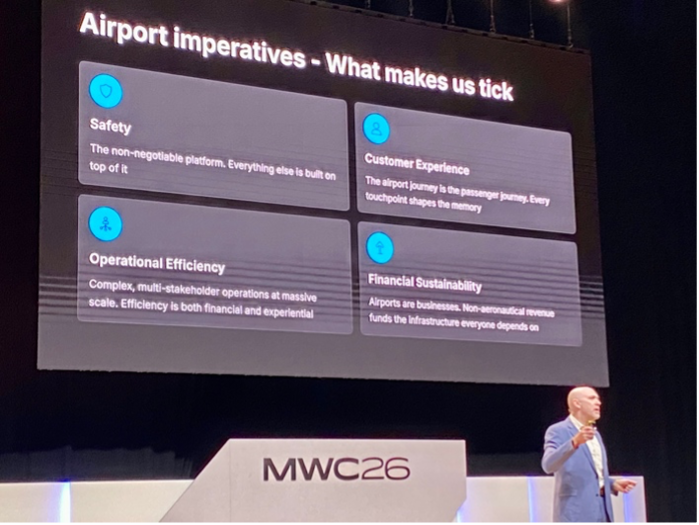
Valencia outlined four priorities driving MSP’s technology strategy—safety, customer experience, operational efficiency, and financial sustainability—and explained how the CBRS network is delivering against all four.
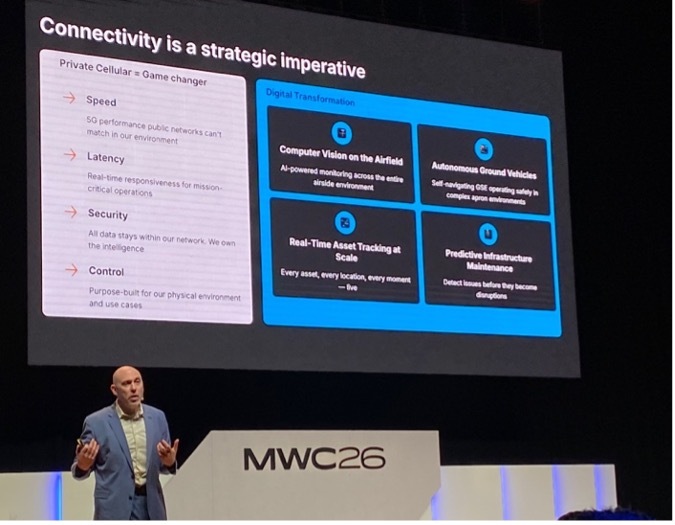
What stood out most was what happened after the initial deployment. Once MSP had access to flexible mid-band spectrum and modern wireless infrastructure, the airport rapidly identified new applications that were never part of the original business case—AI-powered computer vision monitoring across the entire airfield environment, self-navigating autonomous ground vehicles optimizing gate operations, real-time asset tracking at scale, and predictive infrastructure maintenance that detects issues before they become disruptions. That pattern defines CBRS deployments: organizations don’t just solve one connectivity problem, they build a platform for ongoing innovation. As I’ve heard from deployers across sectors, the story is the same—deploy CBRS, then discover what else becomes possible. It’s why the band has earned its reputation as the “innovation band.”
A Global Trend with a U.S. Advantage
MSP is far from an outlier. Around the world, regulators are introducing a variety of spectrum access models to support private networks—locally licensed frameworks in Europe, shared access trials elsewhere—but no country has a private model as mature or as widely deployed as CBRS (and private networks are just one of the deployment types CBRS has enabled). I recently posted on LinkedIn about CBRS’ role in U.S. private networks leadership.
That advantage didn’t happen by accident. CBRS exists because U.S. policymakers made a deliberate choice to open the 3.5 GHz band through a shared access framework. That decision has been validated by thousands of deployments and a growing ecosystem of hardware manufacturers, software developers, integrators, and end users across sectors from school districts to factory floors.
But this advantage isn’t necessarily permanent. As Congress and the FCC consider the future of spectrum policy, MWC made two things clear. First, private networks are now a global infrastructure priority, and other countries are actively building frameworks to compete. Second, the U.S. has a proven model that is already delivering—and protecting it should be a priority.
The world is paying attention. Washington should be, too.