
Airports are complex, always-on environments. From terminals and baggage systems to airfields, maintenance facilities, security systems, and parking structures, reliable connectivity is essential to keeping people, equipment, and operations moving and safe.
The Citizens Broadband Radio Service (CBRS) band enables airports to deploy private 5G and LTE networks using shared spectrum in the 3.5 GHz band, offering a flexible wireless option that can provide greater control, mobility, and coverage for critical operational needs.
For National Aviation Day, we’re spotlighting how Miami International Airport (MIA), Minneapolis-Saint Paul International Airport (MSP), and Dallas Fort Worth International Airport (DFW) are using CBRS to support modern airport operations.
Miami International Airport (MIA): Creating a Smarter, More Connected Passenger Experience

As one of the busiest international gateways in the United States, MIA, a Spectrum for the Future member, manages millions of passengers and thousands of daily operational tasks across a sprawling campus. To support those demands, MIA has embraced CBRS as part of its broader vision for becoming a smarter, more connected airport.
The airport’s private wireless network supports a variety of use cases, including IoT-enabled maintenance, passenger flow monitoring and security, customer service applications, and improved connectivity for airport tenants. These tools help airport staff monitor operations in real time while creating a more seamless experience for travelers.
By investing in private wireless infrastructure, MIA is demonstrating how shared spectrum can help airports modernize their operations while creating new opportunities.
Minneapolis-Saint Paul International Airport (MSP): Putting Private Wireless to Work
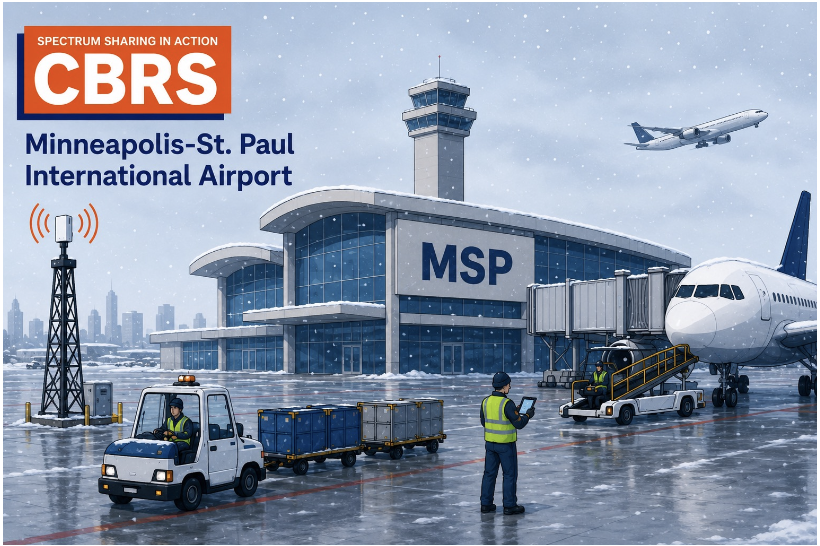
At MSP, airport leaders launched a proof-of-concept project to evaluate how a CBRS-based private network could support day-to-day airport operations.
The pilot examined several operational use cases, including infrastructure monitoring, video surveillance, digital signage, mobile applications, maintenance operations, and the tracking of shared airline equipment.
The results showed that CBRS could provide reliable, flexible connectivity across a wide range of airport functions. The project also highlighted the potential for private wireless networks to reduce deployment timelines, improve operational efficiency, and support future technology investments.
MSP’s experience illustrates an important point: shared spectrum isn’t a future concept. It’s already delivering measurable value in real-world environments.
Dallas Fort Worth International Airport (DFW): Connecting One of America’s Largest Airports
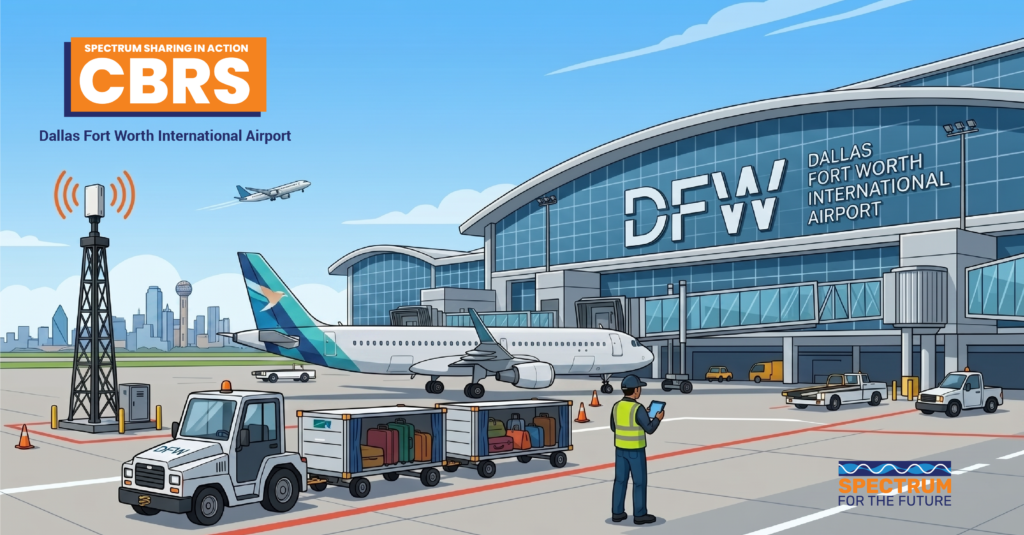
Covering nearly 27 square miles, DFW operates on a scale more comparable to a small city than a traditional transportation hub. Extending fiber across a campus of that size can be both costly and time-consuming, leading airport officials to explore alternative connectivity solutions.
Today, DFW uses CBRS-powered private wireless to support security cameras, construction projects, airfield operations, events, baggage operations, and other critical functions across the airport.
Airport leaders have also highlighted the flexibility that wireless connectivity provides. Rather than waiting for wired infrastructure to be installed, teams can quickly extend coverage wherever it’s needed.
DFW’s experience demonstrates one of the greatest advantages of shared spectrum: the ability to deliver secure, reliable connectivity across large, dynamic environments where traditional networking solutions may be difficult to deploy.
The Future of Airport Connectivity is Already Here
The experiences of MIA, MSP, and DFW demonstrate that no two airports use CBRS in the exact same way. Yet, each has reached a similar conclusion: private wireless networks built on shared spectrum can help solve complex operational challenges while creating opportunities for future innovation.
As airports continue to adopt connected technologies, from IoT devices and smart infrastructure to advanced analytics and automation, flexible spectrum resources like CBRS will play an increasingly important role in keeping America’s aviation ecosystem connected.